

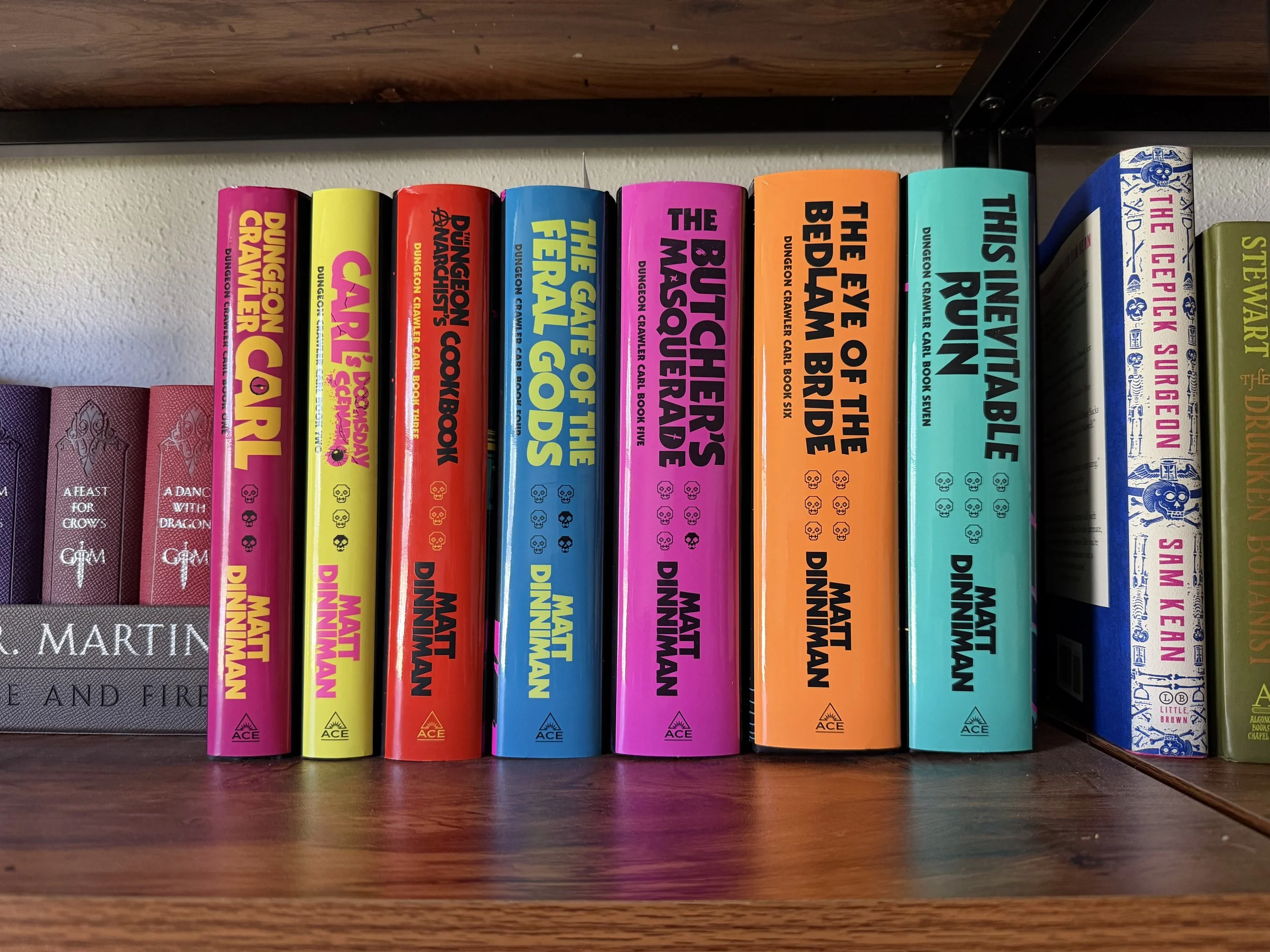
Arguably the most colorful volumes in my library. Image taken before A Parade of Horribles released in May 2026.
Not since the late ‘90s have I seen a series capture such a diverse swath of humanity to the degree Dungeon Crawler Carl has. Matt Dinniman self-published the first book in 2020 and now in the latter half of 2026 you cannot avoid the alluring neon color schemes and cheeky embossed hardcovers of the Ace Books editions and thousands of memes, stickers, shirts, re-bound illuminated editions, fan animations, and cosplays that seemingly exploded onto the Internet in a matter of months. A Song of Ice and Fire might leap to mind considering its influence over games (Skyrim) and television (HBO and every other streaming service coming out in a rash over finding the next epic fantasy novel to serialize). To me, a more direct comparison hangs over this conversation muttering unforgivable curses at the marginalized communities in its author’s sights and at first that comparison gave me pause.
I wasn’t on the ground floor of DCC, just as I wasn’t on the ground floor of Potter despite being exactly the age for it when The Sorcerer’s Stone sold enough for paperbacks to hit scholastic book fairs. In a now grimly humorous bit of foreshadowing, that series was the territory of affluent and mean-spirited children who bullied dullards like me that clung to Brian Jacques’ Redwall books and Oscar Wilde’s fairy tales. By 1999 I still hadn’t read the first book but had frequent run-ins with classmates that had no awareness of who in that narrative they most resembled. The inescapable market capture of Harry Potter continues to churn despite clear warnings that it shouldn’t, something both Tolkien and George R.R. Martin’s works have avoided even though they have spent considerable time influencing media and habits around them. Some might argue that both are also run into the ground and I think most major properties are at this point. The difference is one of these massive franchises is presently being weaponized while the others are prolifically over-exposed in media.
Rowling’s work, at least the early books where that market capture started, allows for easy self-insert. People do create Lord of the Rings and Game of Thrones self-inserts (this is just the nature of fandom) but the broader Potterverse was designed to entice the lonely and the identity-adrift to attach themselves to the idea that the struggle of this world was temporary and any day now an owl might deliver a letter that unlocks their true potential. Pretty compelling stuff when you’re a midwestern child in the early 2000s coping with very real horrors in a 24/7 news cycle. Potter didn’t invent fanfiction but it modernized it, taking a niche hobby more commonly attributed to science fiction series and horror anthologies and encouraging any young millennial with a Xanga or a Live Journal to bang out their self discovery through the guise of telling the continued adventures of their favorite adolescent wizards. The real history of fan fiction is mirky, and with enough tedium and research one might attribute it to any point in human history where a work of fiction or an author’s body of work inspires future generations. Some amount of French decadent literature can be read as Edgar Allan Poe fan fics but the most tangible origins in the 20th century flow from the broader Star Trek community. Slash fiction in particular. Folks were writing Kirk/Spock before the invention of the Internet.
From first publication to the first film adaptation going into production, Harry Potter existed in print for roughly 2 years before putting my entire generation in a pumpkin juice frenzy. That kind of success and turnaround in literature is rare and the series hit the world at a critical time to simply explode. Novel after novel since then gets run through the options mill, novels you’ll likely never know the name of and others still that likely shouldn’t have been considered. Capitalism and child-like wonder converged with such force to create entirely new avenues of emotional and financial exploitation. Each touchstone movie event from the ‘70s to 2001 built upon the last until the early 2000s were overrun by the combined forces of Potter, LOTR, and Star Wars. This was the catalyst for all the brand wars and IP domination we’re struggling through now as companies return to a well-thumbed and rapidly disintegrating playbook of how to market a feeling and a brand over the relevance of the stories being told. A key component to another issue with the Potterverse I’ll only touch on briefly, but if you’re reading my website I can trust you already know the details, is directly tied to this marketing behavior as well. You’ve been sold a feeling, a sense of belonging, and a cherished space that rapidly took on sacred overtones as reality crashed against the bulwarks of nostalgia. In this sense, and only this sense, I understand how hard it is to give up poisoned works.
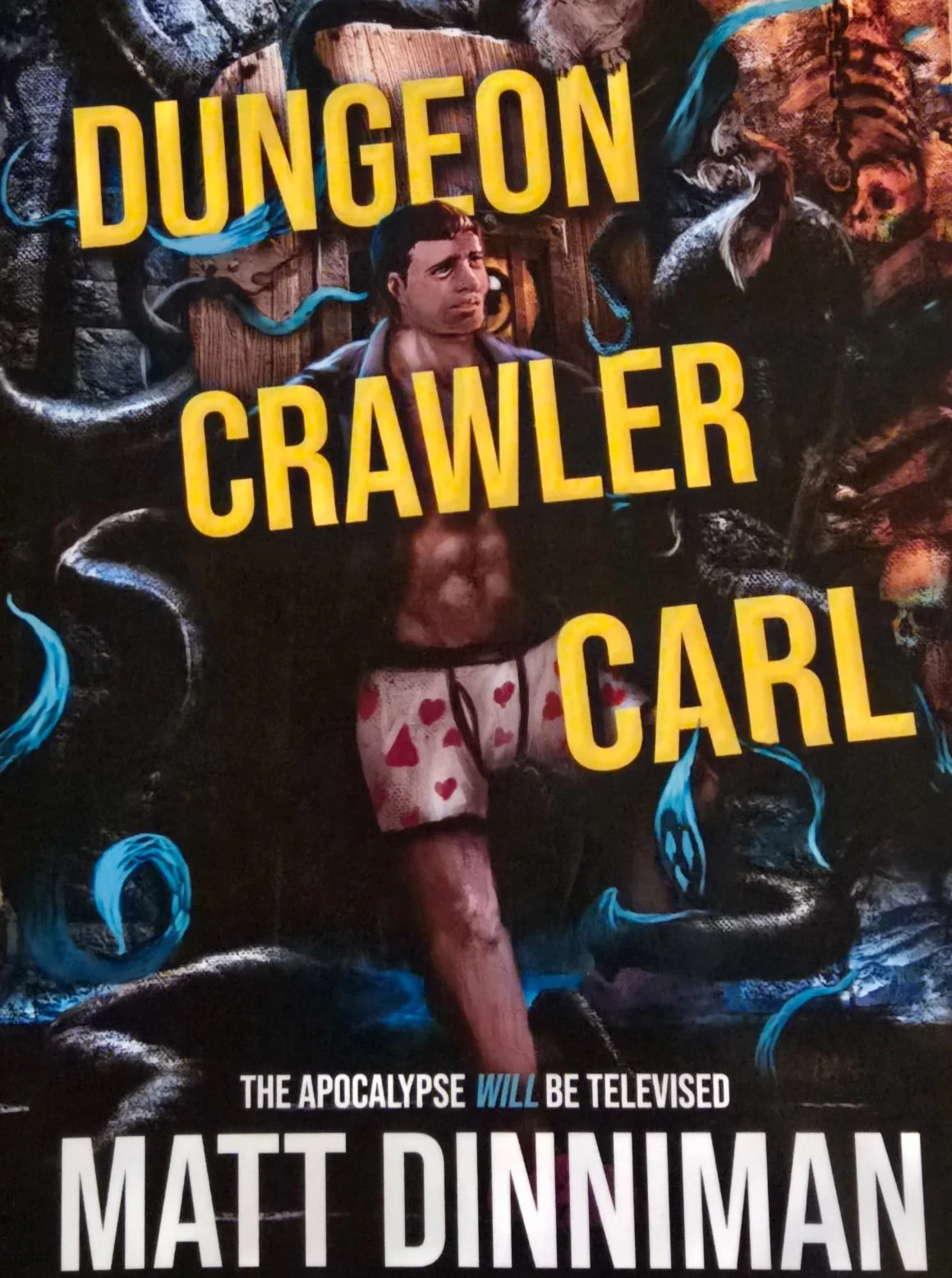
Cover of the self-published edition of DCC book 1. The focus at the time was not on Donut as mascot but Carl as overwhelmed guy.
Comparatively, Dungeon Crawler Carl has been in print for 6 years, though only 2 of those years involve a major publishing house. Dinniman self-publishing rather than going through the traditional agent to publisher to major book deal system delayed the process by which its virality spread if we’re comparing it directly to Potter. But the path Dinniman took is integral to how I view DCC’s rise. Since the broader entertainment world’s obsession with running franchises into the ground has grown ever more desperate, the countercultural move is to seek out artists directly or to plumb the depths of fiction to find something unadulterated and unexpected to escape into. Crowdfunding games, translations, and new books is now commonplace. Some part of that is a symptom of capitalism’s terror at ever taking a risk, but the other is a real awareness that the bigger the company, the less they care about the heart of things. So to anyone seeking a less focus grouped to death experience, crowdfunding and perusing self-published works gives the wandering nomads of fandom something to explore.
DCC fans currently come in 3 forms:
1. Initial supporters who found the first book on the road to publication.
2. People who wanted to know what the book with the guy in boxers and a cat in sunglasses Tik Tok users were fawning over was about and got hooked either reading them or, more often, listening to the audio books.
3. People who encountered the Ace editions in the wild after experiencing some of the online culture and discourse connected to the franchise and are now anxiously awaiting book 9 mere months after the release of book 8. (This includes me)
The underground coolness stage of DCC is officially over. Dinniman now does ComicCon appearances, you can buy candy bars and oversized water jugs covered in Princess Donut sayings and references to the books, and Seth MacFarlane’s production company Fuzzy Door officially acquired the rights to adapt it into a show. Two years in the official publishing pipeline and the door is open, now into a world more responsive to the tastes of Millennials as adults rather than as wide-eyed children. Overworked, overtired, and over-encumbered by the sheer scope of wretchedness spewing from the highest offices in the world, Millennials are starting to abandon the hopecore and stomp claps that fueled us in favor of a grizzled appraisal of reality as, well, fucked up. Many of us have been broken by the unending descent into self-destruction humanity is presently engaged in, while many more are starting to exclaim “You will not break me.”
Where Harry Potter gave us an easy enough to grasp world in which the forces of good must unite to overcome the unyielding schemes of evil, DCC is a reflection of humanity at the end of the line. Beyond this point I’ll get into a few mild spoilers but I will limit what I say purely to my interpretation of Carl and what he represents. I’ve personally only read through book 5 with 6 sitting in my satchel. Before February, I’d not read any of them, and by the time book 8 dropped I resigned myself to the fact I’d need more time. But all that is to say, I won’t be spoiling anything from book 8 and will do my best to not tarnish the journey should you want to read the series yourself.
Carl is one of the last humans on Earth after a sudden collapse crushed every vehicle and building on the planet’s surface. He’d likely have died like everyone else in his apartment building if it weren’t for his ex-girlfriend’s prized show cat Princess Donut, a tortoiseshell Persian, running out into the night shortly before this calamity. Carl is a former national guardsman turned marine mechanic with a complicated childhood licking his wounds as he discovers his girlfriend is on a family vacation and brought another man with her. Despite Donut being her cat he’s developed a soft spot for her and that tenderness leads to him out into a freezing winter night in his boxers, a leather jacket, and pink crocs that don’t fit his feet to get the cat out of a tree.
Once the world flattens, Carl is left with Donut on his shoulder and the alarming invitation to descend one of the staircases that suddenly appeared into what he’ll later discover is called the World Dungeon. Motivated purely by not wanting to freeze to death, Carl and Donut go down the stairs and embark on a violent quest to free themselves from the machinations of intergalactic mega corporation empires. The Crawl is a reality TV show, not entirely dissimilar to The Hunger Games, where the remaining population of a planet slated for demolition are invited to win their freedom by reaching the last floor of the dungeon. The catch is, no one ever truly wins as the most beloved and successful crawlers frequently cut deals with the mega corps that take turns running the show to sell their eventual freedom in exchange for serving as non-player characters in future crawls. These former crawlers can eventually see the end of their indentured servitude but only after decades, if not centuries, of living within the confines of their roles and facing the very real scenario that they’ll be killed in the game by the designers or the crawlers they meet. This seems like a bad deal, and it is, but the moment a crawler is presented with that choice they’ve reached a breaking point where escape, no matter how delayed or misrepresented, is preferable to continuing to fight.
Already you can see the framework that might appeal in our current situation. To some degree, we are all trapped in the dungeons mega corporations have constructed for us, be it student debt, credit card debt, medical debt, housing insecurity, financial stagnation, and diminished work/life balance and access to self-determination. For those in power, flexing control and depriving underclasses of resources is how you maintain power and that limited worldview frequently trips itself up when their intentions become known. Corporations in DCC have exploited this system for thousands of years because the planets that “host” The Crawl are unaware that life exists on other planets and their first contact is a series of eminent domain actions they never had the power to stop.
Carl as a protagonist is just a guy. He has some skills but nothing that lends itself to surviving in a role-playing game. He is relatively young (he’s depicted as being around 27) but starting to reach the first milestone in life where one takes stock of how their life is going, and he has decades of unresolved trauma he’s not slowed down enough to unpack. He is any American person between the age of 27 and 40 who feels adrift in life and hasn’t figured out who they are and is starting to suspect who they’ve been isn’t the best choice. The nature of US culture in particular right now traps anyone under retirement age in a cycle of perpetual infantilization and self-doubt, only deepening the ongoing feeling that life is both pointless and something you’re failing at.
“You will not break me” is Carl’s internal battle cry as the harsh realities of what The Crawl asks of crawlers and what the gamemakers actually want are revealed to him. Slowly, and with the confidence you muster when your back is truly against the wall, Carl embarks on a one-man war against the entire universe, making dear friends and profoundly powerful enemies. He is an agent of rage hellbent on tearing down the systems that ruin trillions of lives because this dire situation he’s stumbled into is the catalyst for not only examining his past but assessing what truly matters to him. Humans are dangerous creatures when we’re threatened, something the gamemakers are aware of but not overly concerned about until the same mechanics of capitalism that are ruining all the technology we use today begin to undermine their perceived invulnerability.
Where Harry Potter engages in what I’ve come to view as a childish and simplistic concept of good over evil, Dungeon Crawler Carl is filthy and burdened by the perception that goodness is not inherently beneficial if it serves the ruling class. Everyone is weighed down by the ghosts of their pre-crawl lives and are having understandable psychological breaks as they experience horrible, and deliberately traumatizing, battles. The world is over. All anyone has is their sense of self, something the game is also designed to deteriorate as crawlers can take on entirely new races and powers that remove what of their humanity remains. The rich and powerful throw cash around to prop up crawlers they like or to conspire against the crawlers causing them to lose money and favor. Crawlers are a spectacle and are not viewed as beings deserving of rights. In most cases they’re playthings and hunting trophies, not the last remnants of a species in the throes of an extinction event. Once they’ve fulfilled their purpose they’re either dead or trapped in the machine, waiting for another planet of unaware survivors to throw their bodies into the grinder.
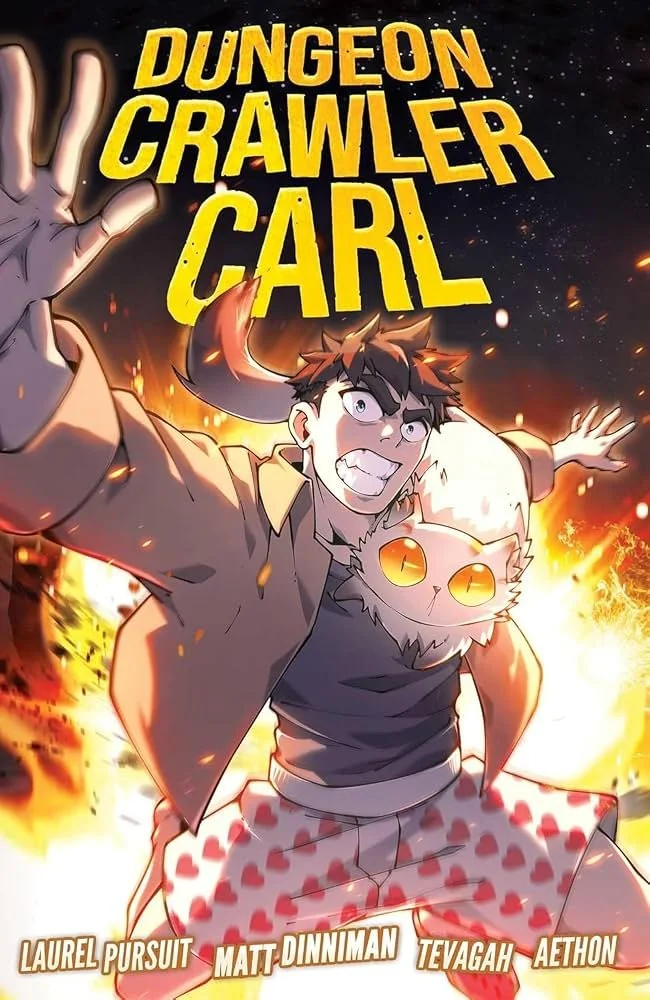
I made a point to describe what kind of cat Princess Donut is to highlight one controversy regarding her: How she’s depicted in the comic book adaptation that launched in 2026. Just in case you thought I was overlooking issues in the community regarding strict interpretations of the text.
It might not sound inspiring or hopeful, but to me that’s exactly why this series’ popularity matters. Much like The Hunger Games before it, the central ideas beyond the set dressing, and the pop culture references and the talking cat, ask the questions “why do we suffer the indignity of power bludgeoning us” and “can a seemingly hopeless system of exploitation be stopped and if so, how do we do it?” The seeds Katniss Everdeen sowed in pop culture are now mature and bearing the fruit Carl is fortified by. The similarity between these stories is a continuing conversation about our real-world agency in fixing even one thing that’s plaguing humanity. For too long we’ve rested with the idea that good will ultimately prevail but what if that happening depends on a person descending into something primal and wresting that victory for humanity from the hands of power through force? This is the same struggle Star Wars depicts, we’ve just long since lost the fight against those who would worship the Empire over empathizing with the Rebels.
Carl is not asking for empathy. He is demanding justice for generations of beings he will never know as well as his own species in a system they had no agency in. While wrapped in humor and gross-outs, Dungeon Crawler Carl is an unexpected study in what it takes to preserve yourself, and what extremes you may have to go to in the fight to not be broken by the system you never agreed to participate in. Carl’s sense of self is brittle and his tolerance for the white hot anger in his blood is weakening with each new floor he narrowly survives. He is just a guy in a fucked up situation who knows beyond a shadow of a doubt that whatever universe is left at the end of The Crawl, he owes it to himself and every crawler before and with him to make damn sure it is different rather than letting it break and control him.
He's not some divinely appointed hero. He’s a dock worker who loves his ex-girlfriend’s cat to the point he would fight gods and every Fortune 500 company to the death if it delivered Donut into a better future. Whom among us would not spit in the eye of power to save our pets and loved ones? Perhaps we don’t know how far we’d go to do that but Carl is making good on the expression “I would die for her” that has passed untold millions of Millennial lips in jest.
Where the Potterverse invited readers to escape into a charming but harrowing world where magic is real and you’re just one fanciful letter away from finding yourself, Dungeon Crawler Carl meets us where we are as the promises of a bright future are taken from us in exchange for a life of toil explained away as some duty before God and country. There’s nothing wrong with engaging in self-soothing lies about how progress happens but eventually you have to accept that they are lies. The world Dinniman created is a surreal reflection of the fight we’re already in. Our choice, the one Carl repeatedly presents us with, is are we going to allow this fight to break us or are we going to break the systems instead?
I did not expect to find such profundity in DCC when I picked up the first book. All I was seeking at the time was a distraction from the news and some rare moments of losing myself in fiction. I certainly got that, the elements of this series I’ve deliberately left untouched in this piece do provide fun and distraction. Over time, however, this other truth started to emerge. The fight for justice is grueling and is taken up by imperfect people with imperfect solutions just trying to do anything to free themselves from tyranny. What remains to be seen is who Carl ultimately becomes as he inches ever closer to the 18th and final floor of the World Dungeon. And that’s our work now as well. Who will we be when our current fights are over? How do we know if what we’re doing is the right thing when resistance is met with predictable outrage and violence from those who know their grasp on control is slipping?
As DCC’s fanbase grows and people self-insert into the World Dungeon, I am curious to see how people take to the things I’ve gleaned. With any literary interpretation there’s a degree of bias originating from that person’s perspective. I’m interested to see how far Fuzzy Door Productions will allow these ideas to flourish. As I’m writing this, only one cast member for the show is official and it is Jeff Hays, the narrator for the audiobooks, reprising his role as the voice of Princess Donut. This is a good sign that Fuzzy Door means to appeal to the fan base but I’m keen to know if that extends to the ultra annoying fans like me who want the heart of the text on display instead of the set dressing.
Truly, I didn’t think I’d become as enamored with Dungeon Crawler Carl as I have but it hit me at just the right time. The same way Harry Potter hit so many kids around me at just the right time in the late ‘90s. This is the series for our age, wrestling with the complexities of loyalty and brutality and what that does to a person and how we build a world we actually want to live in. Instead of seeking solace in rose-tinted memories of one we cherished as children, we’re invited to face the horrors of our complicity in the mechanisms further grinding us into dust.
Glurp glurp.