

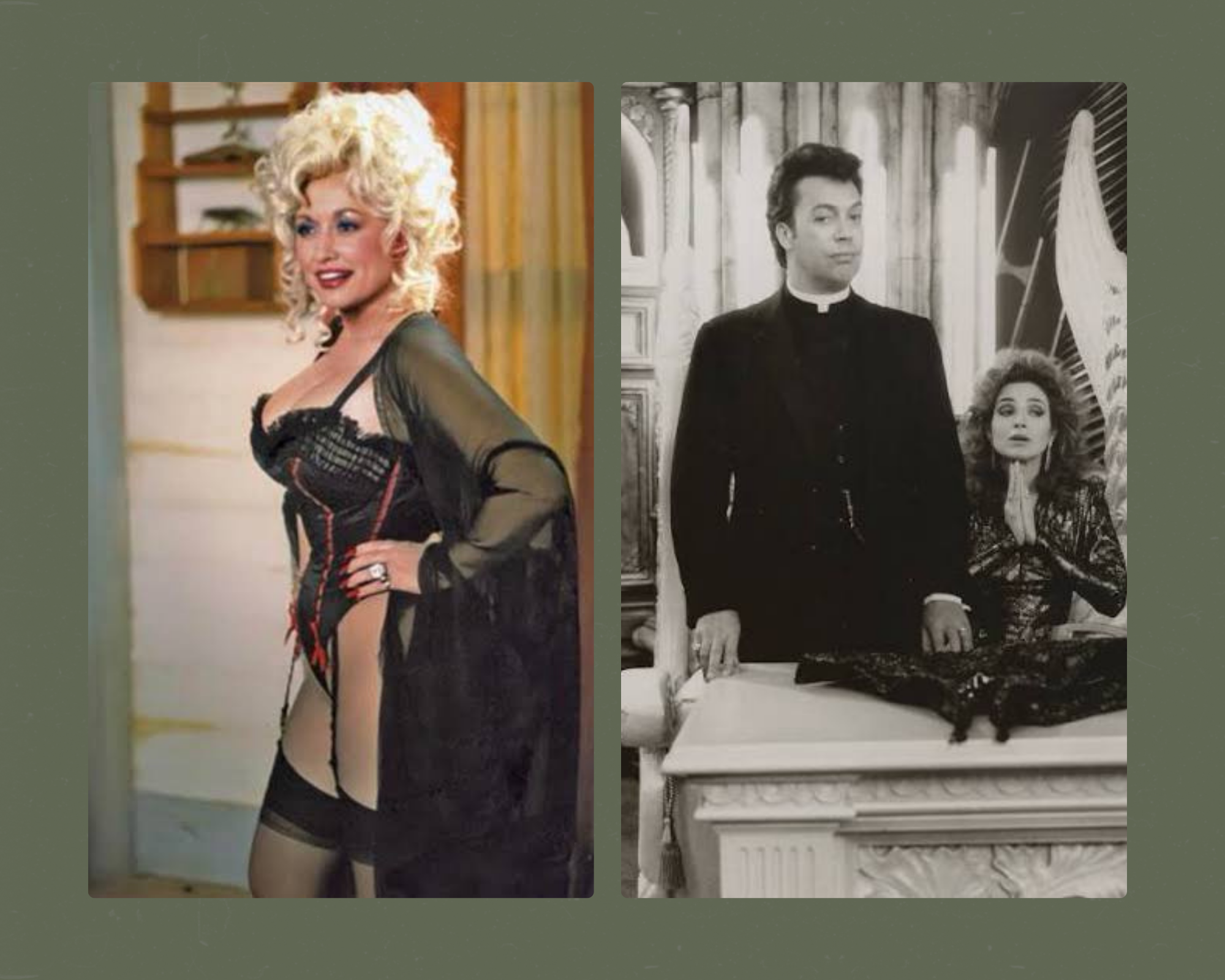
Dolly as seen in The Best Little Whorehouse in Texas and Tim Curry and Annie Potts as they appear in Pass the Ammo
A story my mother often told me over the years begins in roughly 1989 or 1990. My parents were young and scrambling to navigate life as parents in poverty, and any luxury they purchased had to serve multiple uses in our household. Buying a VCR in the late ‘80s could set you back $200-500, which was a far cry from the $1000+ price they commanded throughout most of the decade but not necessarily affordable for many. After struggling and failing to repair a Betamax player, ultimately a VCR became a necessary purchase and that introduced a whole new kind of economic anxiety regarding access to tapes to put in the damn thing. Key to my mother’s story is that a hunt for things to watch led her to stumbling across a bootleg VHS of The Rocky Horror Picture Show complete with Japanese subtitles. What she didn’t know at the time was how obsessed the barely lucid bundle of cloth in her arms would become with that tape.
She claims I was two years old when I demanded to watch RHPS on loop. Mom rarely worked throughout my life so many of my early years involved her figuring out how to care for a kid on her own for several hours a day. Without resources to swaddle me in a child-only media landscape, she had to reconcile what of her tastes she could share with me. At 2, you’re not really parsing what you watch with any depth beyond the sights and sounds that catch your attention. And boy was my attention drawn to Tim Curry (lovingly referred to as uncle Tim by my mother for years after). While I can’t fully recount how I felt about RHPS at the time, I have an awareness of how ensorcelled I was as it extended well into my teens. Apparently I would dance from the moment “Science Fiction Double Feature” started and be passed out on the rug by the end of the film. Lacking awareness of any themes or plot, I craved the music and pageantry and the joyous celebration that possesses young minds experiencing something they like free from the demands society places on our jubilation. Even as my parents provided more child appropriate offerings, the gaudy clear plastic VHS box with its blurry mishmash cover hastily printed on red construction paper was the only thing I ever wanted to reach for. By 1991 only one other movie had joined this rotation and it was Hook. Ever the analyst, my mother was beginning to connect dots on who I might become.
Over the years she returned to this story with more insight into how foundational RHPS was to how I was growing. She watched as I made deliberate choices aligned with who I wanted to be and not what other people forced upon me. She took note of how little interest I had in performing enforced gender roles, something she and my grandfather lovingly allowed me to explore because they shared a mutual distaste for both conformity and trapping people in lives they don’t want to live. Grandpa had been running from his despite remaining a farmer, and mom did try to change her circumstances too. Both presented me with the reality that I can like what I like and do the things I want to do simply because they are things I feel passionate about. They didn’t have the language for filtering this through gender and sexuality but by the end of both their lives they fully understood who I was and their part (in some way) in empowering me to exist authentically as myself. All the more reason Richard O’Brien’s views on gender shifting over the years is infuriating. He wrote The Rocky Horror Picture Show, he’s even Riff Raff in the film adaptation. He wrote the musical centering the tensions of conformity, self-expression, self-realization, and gender only to end up in a befuddled swamp of walking some of that back the moment discussing gender became controversial in less fun ways. O’Brien isn’t as integral to this story as Tim Curry is but his journey in the 21st century is so disappointing this is the third time I’ve written something about RHPS that I felt compelled to express my disappointment about him in so thanks, Richard.
Because I loved RHPS so much, mom made a point to put any and everything Tim Curry ever made in front of me, from his brief music career to Legend, then Clue, Muppets Treasure Island, Congo, The Shadow, The Three Musketeers, the list is endless but integral. A film I make a point to share anytime Tim Curry’s importance is brought up is Pass the Ammo, a deeply under-appreciated film from 1988 where Tim Curry is a televangelist preacher in Eureka Springs, Arkansas up to no good. Bill Paxton concocts a plan to rob his church during a telethon to reclaim the inheritance his girlfriend lost when her now deceased relatives signed it over to Reverend Ray’s (Curry) ministry. Annie Potts is also undeniable as a Tammy Fae-like beacon of religious extravagance. This film, beyond even RHPS, matters most to me. It released the year I was born and was filmed in a town I adore, people I know in real life are in it, and it highlights a struggle in Arkansas state politics I only grew to understand better through revisiting the movie over the years. It feels like home and even if Curry’s character is objectively terrible he’s absurdly, comically evil. He can command the fiery speech preachers depend upon in one scene and you watch that godly authority unravel in real time as the robbery turns into a hostage situation.
Hopefully this copy stays up on Youtube after I’ve shared it across the Internet. Pass the Ammo never received official DVD or Blu-ray releases, just VHS and Laser Disc. Someday I hope to find a way to rip the Laser Disc copy before it’s devoured by disc rot. I haven’t opened it in years out of fear.
I also haven’t watched The Rocky Horror Picture Show in close to 20 years now. Even if I don’t engage with it, the foundation it built in my appraisal of cheesy sci-fi elements, dramatic costumes, and my own sense of self is as firm as ever. My obsession with Tim Curry’s energy and voice persisted and no corner of my childhood is disconnected from his body of work. While he had no awareness of who I am, and I never wanted to try to meet him because I worry about how thin the line between fandom and obsession can be on the receiving end, my mother calling him uncle Tim really sums up my appraisal of him. He was like a mysterious uncle you never really met but loved hearing the exploits of. Even my joke about becoming an Occult Uncle to my friends’ children stems from this concept of an unrelated but no less fascinating (and maybe unintentionally influential) figure in life. What Tim Curry leaves behind is thousands of entry points into a life and career seemingly motivated by his own choices and an appreciation for performance as craft. He took compelling, flashy roles, he took weird and broadly unimportant roles and breathed unexpected life into them in a way that frequently gets maligned as simply the work of a “character actor”. Isn’t the point of portraying stories on stage or in film to embody and project the character you’re cast as? The term “character actor” used negatively against the ideas of leading roles has never set well with me. Life shouldn’t be a constant pursuit of being the best or earning the most money or having the biggest, best things. Life is something you should experience and imbue with meaning on your own terms. A career like Curry’s reflects this idea and the genuine sorrow flowing from all corners of the world at his passing isn’t dependent on him having been the most successful leading man.
People care about Tim Curry because he gave voice and form to ideas and characters with lasting appeal, often made more appealing because of how he performed. To me he is a distant influence on how I set about figuring my own life out, never a direct reference or idealized path to follow. He presented the notion that enjoying what you do and being good at it should be satisfying to you, something Curry seemed genuinely appreciative of as he experienced the RHPS fandom over the years. I think he understood his influence despite being intensely private, growing ever more reclusive as his health began to deteriorate. I’ve purposely never taken much interest in investigating his life because what truly matters to me and the world are the lives he lived within media. His art is his lasting contribution to the world and I’m grateful I was reared on it. My mother was unaware of how consequential her decision to distract me with RHPS was, and I refuse to give into the idea that it had any direct influence on how queer I am today. But it certainly provided an in on how I think about myself in relation to media I might not have had without those formative experiences.
Originally when I sat down to think about death and influence, I’d intended to write solely about Dolly Parton who also passed away on August 25th, 2026. I didn’t learn of Curry’s passing until this morning, like most everyone else in the world. So what I’d started writing about Dolly is now a deeper look into what the lives of famous people mean far removed from the lives they lived directly. Where Curry is a shining example of why life is worth living on your own terms, Dolly enters as a representative of doing just that but also of breaking generational cycles and extending kindness far beyond yourself. My first encounter with Dolly isn’t that far removed from Curry, either.
I didn’t really know who Dolly Parton was the day I came home from school and my mom was excited to show me a movie. I cannot date this the way I can RHPS but I recall the heavy odor of crushed and overripe persimmons from the trees surrounding our apartment in Tulsa in the late ‘90s. Persimmons are shockingly prolific in Tulsa, and even in the middle of the city they fed the often stressed wildlife contending with traffic and pavement. I smell that smell every time I think about The Best Little Whorehouse in Texas, the movie mom was thrilled was airing on likely Starz not long after I got home. This is not a choice a parent in our current climate is likely to make but mom never had much interest in “shielding” me from reality.
Knowing I had little context for the movie, she pitched it with “Burt Reynolds is in it” because I shared in Hitchcock’s love of Smoky and the Bandit. That was enough to get me to sit down, unaware Dolly would stop me in my tracks.
Parton’s entrance as the bombshell madam of a rural Texas brothel giving way to a full dance number outlining the rules her girls operate under was a lot for a kid who had likely been thinking about watching Pokemon when they got home. I realized instantly I knew her voice but hadn’t done much investigation into who Dolly Parton is. That, I think, was my mother’s point with this. Introduce me to a Parton film she enjoyed while also engaging with the idea that sex is not inherently bad and, as the song points out, nothing dirty is going on.
I wouldn’t go out of my way to say this is one of the greatest films of all time but Parton’s involvement is still fascinating. A well-known devout Christian country star embarking on a new chapter of her fame after the success of 9 to 5 and fully embracing the raunchy, playful nature of a musical about the fall of a rural Texas whorehouse makes perfect sense in context of how Parton navigated the world. She was no stranger to her own sexuality and sex appeal, she was hilariously glib about the effort and intention behind her appearance until her final hour. She embraced the painted, exaggerated aesthetics she will be remembered for because she found these traits beautiful in others. She saw glamor as an ideal one could embrace but never one that excluded her from the teachings of old mountain Christianity. Jesus befriended the unwanted and downtrodden, finding beauty and worth in all people and preached on the importance of uplifting others and healing the sick. The ideas attributed to Jesus rang like bells through rural congregations. While we’re contending with the machinations of Evangelical extremism right now, that was not the world that raised Dolly. Toiling endlessly in life in hope of the restful respite of heaven was more the reality she lived and witnessed her family and neighbors live. Good people can and do live complicated and messy lives. Faith is not a tool for ending human complication and diversity, it is a way for us to embrace our diversity under the idea that God made everyone and everything and our job as people is to seek peace and community with all of God’s creations.
She wasn’t afraid of portraying complicated people with good hearts, something The Best Little Whorehouse in Texas delivers down to Parton’s character delivering insights on Jesus’ friendship with prostitutes. Sex work is work people have engaged in since the rise of human civilization, and Jesus’ position on this seems to continue the notion that the work itself is not the problem. How people treat this work, and the people who do it, was more what Jesus was pissed off about. The same struggle Mona Stangley faces as a fame-seeking “journalist” from New Jersey intends to use the exposure and destruction of a quietly respected and protected brothel to fuel his rise to fame. Dom DeLuise’ character is the force of puritanical judgement that is incongruent with Mona’s profession despite Mona’s clear understanding of both her duty as a madam and concept of self in the context of her faith. Sex work isn’t shameful and the surrounding towns didn’t seem to mind until someone very loud came in with the intent to make a name for himself at the expense of others.
Mona’s earnest appeal on the nature of religion in regard to her work stuck with me. That was not the context I had from life. Religion up to that point really was some mix of exploitation and bullying, not a genuinely thought provoking consideration of how we treat one another. But the difference is I was dealing with Christianity in the shadow of the Satanic Panic, not the Great Depression. A lot had happened even in the decade and change since The Best Little Whorehouse in Texas was filmed and I saw it in the late 90s. Dolly, and this movie, were visions of a reality that could have been, one that embraces expression and personal freedom as divinely appointed rather than something God is angry you get up to.
Dolly would go on to use her fame to enrich the world around her. Dollywood theme parks provide economic enrichment to Pigeon Forge (Dolly is from nearby Sevierville), she created the Imagination Library to encourage literacy in children in honor of her father who was illiterate but encouraged her to always keep learning, and she is even a factor in Moderna’s Covid-19 vaccine entering production faster than it might have without her contributions. While you can find people who are against all of these things, what unites them is Dolly considering how one gives back to the world while clearly profiting from it, and how one can care for people you’ll likely never meet in ways that could encourage others to pick up that work. Beyond direct philanthropy, Dolly advocated on behalf of the LGBTQ+ community against the worst excesses of others who also claimed to be Christians but the sort willing to run a brothel out of town in a fit of performative violence rather than ever embrace the messiness of human desire.
As a queer child of the Ozarks, barely 2 generations removed from share croppers, learning more about Dolly and watching the grace she moved through the world with left me in awe. Here was a good person who loved how she looked, made no apologies for her authenticity, and embraced the world with love. She moved in silence for humanity while writing beautiful, soul-filling music. She was aware of her presence but never outwardly consumed by the accumulation of wealth to a degree we see from the ultra wealthy presently gnawing at the planet. She remained in a long, committed relationship with her husband despite being, and embracing the fact she was, a sex symbol. Attraction, appeal, and unspoken but profound feminism went hand-in-hand with her Christian perspective because these elements assembled the whole of a person. If a city could become a person, the same Eureka Springs I mentioned in regard to Pass the Ammo is who Dolly was.
Eureka is a town in strange tension. Home of a high budget Passion Play and the Christ of the Ozarks overlooking these hills like a deformed Cristo Redentor, Eureka Springs is also the most out and proud little town in Arkansas. Pride celebrations and folk music co-exist with heavy religious overtones (brought to the region by Gerald Lyman Kenneth Smith a prolific fascist and anti-semite seeking to remake an economically downtrodden area in his image) to the point an entire documentary engaging with the complex heart of the city exists. While Dolly has nothing to do with Gerald Smith, the forces Smith’s harsh and hateful application of religion employ are the very ones Dolly spent her life gently trying to defeat. Just like a sleepy mountain community that delights in its complexity and is not ashamed to link arm-in-arm with people from all walks of life to celebrate that diversity. Canonized by her queer fans long before her death, Dolly is the saint of this joyous cacophony who reminds us to lead with love where others prefer to harden their hearts.
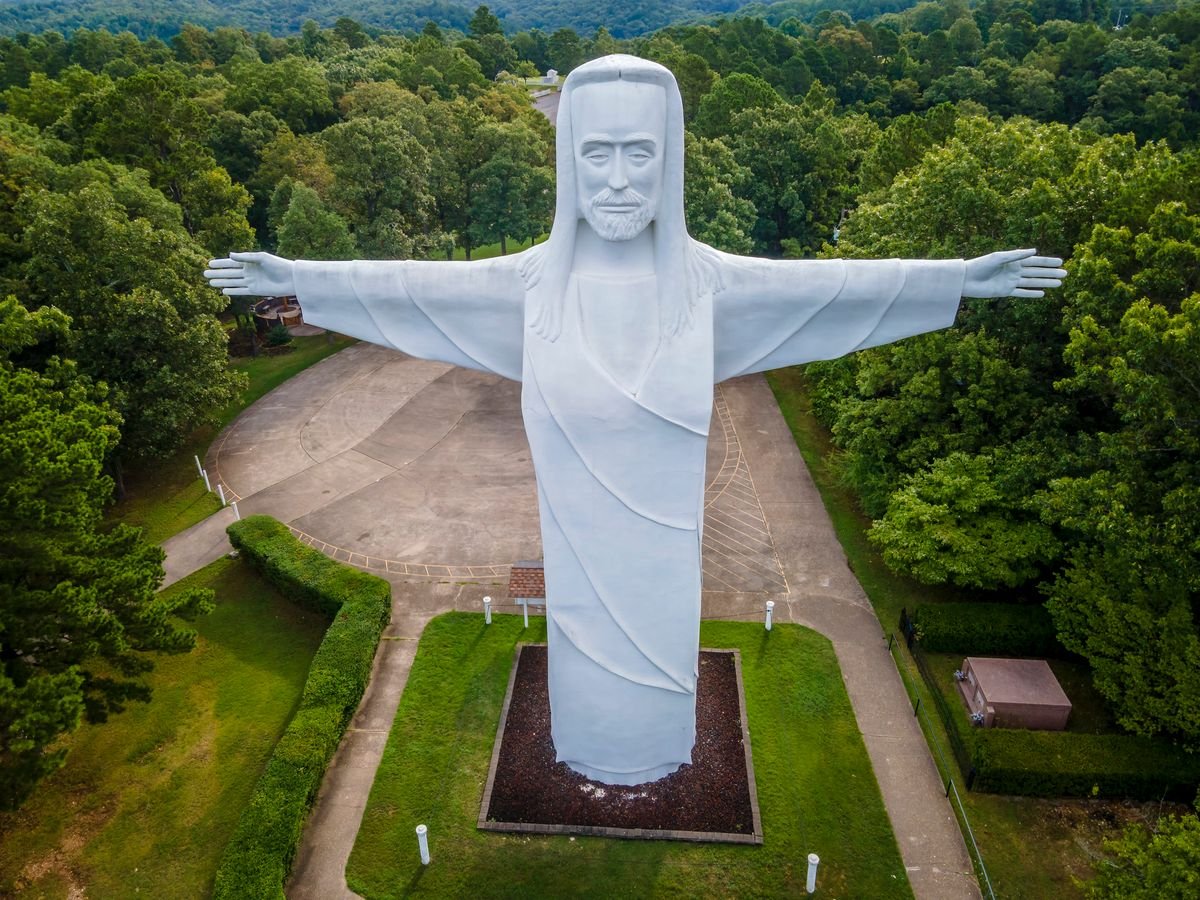
I’ve never liked this statue for aesthetic reasons but if this depiction of christ looks a bit bisected, that’s because it is. Back when the statue was built the FAA required that the statue either get shorter or have a beacon attached to its head as the swatch of Ozark mountains it’s nestled in is active air space. Rather than “disgrace” Jesus with a red flashing hat, his torso was cut out so now his upper chest rests on what originally was the statue’s hips. It was bad before that happened but woof.
Both Dolly and Tim Curry orbit my understanding of myself in ways I’d never thought to link until their untimely passing in the same 24 hours. As manifestations of committing to your art and utilizing your access to benefit the world, the tremendous outpouring of love and grief for both is comforting. In a world were every death has a risk of exposing the monstrousness of a life, that’s not the lives they lived in the minds of their fans. Tim brought characters to life in a way inextricably linked to who he was and dared us to explore self expression, and Dolly never ceased to balance her desire to perform and entertain with her commitment to loving people in return. Together they form a powerful cultural touchstone for so many people who find themselves adrift in their bodies and their lives. To be truly beloved isn’t something you can manufacture (not that that stops people from trying) it’s something you arrive at through how you’ve engaged with the world and bestowed upon you by lives you have touched.
I’ll never know Tim Curry or Dolly Parton. My mother introduced me to their work and nurtured that interest because she saw the joy she found in it reflected in me. She struggled to truly understand me but found music and movies were a way to bridge the divide and find that understanding. The influence Dolly and Curry have over me isn’t the sort of inspiration that directly feeds into music or film-making but one that makes it easier to reject calls to cease living authentically. You can be introverted after a life of extroverted performance. You can be dolled up and flashy and deliver more direct good in this world than many preachers diving into the collection plate like Scrooge McDuck. You can dare to live with a consistency and ethic that is influenced by others but is ultimately constructed by how you want to live and be remembered. You have agency to create and you have agency to reject.
My hope is that people who grew up in the ‘90s think back to the access we had to compelling, strange, and unconventional entertainment. Weird budget movies only a handful of people remember, zany sex comedies directly taking on and mocking the rising tide of outmoded moral panics, and a sense of optimism about humanity we presently don’t see reflected in a lot of the things we make today. We’ve lost taste for imperfection and for not arriving fully assembled. The commodification of experience has rapidly transformed into a series of benchmarks people hurl their bodies at in a desperate attempt to “live correctly” in a world that’s not compatible with turning existence into data points and machined precision.
The world is messy. The world is scary. The world is full of wonder and beauty that we find and create for ourselves. While we mourn two tremendous figures in entertainment we should consider taking up some of that fight ourselves. Do we want to live in a world where how much you make is the only determining factor of your worth as a person or do we want to live our lives as we want to live them? We’ve slowly had our connection with how complicated but rewarding existence is stripped from us and we have to find it. Moments of intense sorrow can give way to new perspectives if we allow ourselves to feel and process that sorrow.
I’m no stranger to the idea of pain as something you have to experience. Just like defeat, frustration, and failure. We are strengthened by risks and failures as much as success and acceptance. As we spiral ever further toward a vapid, meaningless life dictated to us by those that would extract their fulfillment from the labor and oppression of others, look to the figures who rejected these things in their lifetime. We have to face the messiness of being animals and the ability we have to construct and extrapolate. Perfection is not the ideal. Living authentically is. What that means is individual, and that’s a scary prospect. Who are we without being told who we’re going to become? Perhaps life is a coat of many colors and the portrayal of a thousand lives as we wander, ever closer, to the real version of ourselves.